Hiển thị các bài đăng có nhãn South America. Hiển thị tất cả bài đăng

Thứ Sáu, 4 tháng 3, 2022

Destination Inspiration: San Juan, Puerto Rico

Destination Inspiration: San Juan, Puerto Rico

 Worlds collide in San Juan, Puerto Rico’s vibrant capital, a simmering melting pot of indigenous, European, American, and Afro-Caribbean cultures with endless attractions to delight all types of travelers.

In Old San Juan, time stands still. Candy-colored colonial houses line the cobbled lanes that criss-cross from Plaza Colón to the 17th-century San Juan Gate – once the main entrance to the walled city. All along the water’s edge, fortresses stand watch from towering cliffs, their cannons still aiming out over the sea. Just outside the old town, the rocky shoreline gives way to the soft sand of El Escambrón Beach, a sheltered snorkeling and swimming spot.

El Morro Fortress, Puerto Rico

San Juan’s cultural fusion is never more evident than in its food. In the city center, upscale European restaurants sit alongside street stalls and fast food joints, while home-grown chefs like José Enrique take traditional cooking to fine-dining heights. The stand-out local dish is “mofongo” – fried and mashed plantain stuffed with crispy bacon, chicken, or prawns.

No matter the time, one thing’s for sure – the smell of freshly roasted Puerto Rican coffee is never far away. You’ll find it served milky at breakfast, or as an afternoon pick-me-up paired with pastries in Spanish-style cafés.

When to go?

A waterfront view of Old San Juan, Puerto Rico

A waterfront view of Old San Juan, Puerto Rico

San Juan’s tropical climate makes for warm, humid weather all year round, with average temperatures rarely dipping below 77 degrees Fahrenheit. Bargain accommodation prices can often be found in September and October – but bear in mind that these months are the tail end of the Caribbean hurricane season.

Where to stay?

Best Western Plus Condado Palm Inn & Suites – San Juan, Puerto Rico

The outdoor pool at the Best Western Plus

The outdoor pool at the Best Western Plus

This modern hotel is just a short distance from the waterfront, in the upscale Condado neighborhood. Its beach club and outdoor pool score highly with Booking.com guests, who also sing the praises of the friendly staff. The bright rooms and suites – some with sea views and fully equipped kitchens – are another big plus.

Villa Herencia Hotel – San Juan, Puerto Rico

The restored Villa Herencia Hotel

The restored Villa Herencia Hotel

This restored villa in Old San Juan is full of old-world charm. Booking.com guests rave about Villa Herencia’s eclectic design, which blends historic features and antique furniture with bold modern artwork. They also love the tropical feel of the roof terrace – complete with exotic flowers, sun loungers, and even roll-top baths!

La Terraza de San Juan – San Juan, Puerto Rico

Wonderful views from La Terraza's rooftop pool

Wonderful views from La Terraza's rooftop pool

A roof terrace with a plunge pool and breathtaking sea views makes this boutique hotel a favorite with Booking.com guests. Set in a colonial house in Old San Juan, La Terraza de San Juan also wins rave reviews for its mix of traditional and modern design.

How to get there?

The easiest way to get to San Juan is to fly there. There are direct flights every day from the US and Canada, with most of the traffic coming through Miami and New York. Getting to San Juan from further will usually involve at least one layover. There are daily flights from Amsterdam and London with only one layover, whereas a trip from Sydney will involve two layovers. If you’re planning a trip from within the Caribbean and prefer a more scenic route, there’s a weekly ferry from Santo Domingo in the Dominican Republic, which takes around 13 hours.

Thứ Năm, 3 tháng 3, 2022

6 must-see pre-Hispanic sites in Mexico

6 must-see pre-Hispanic sites in Mexico

 Pre-Hispanic ruins can be found all over Mexico, serving as a constant reminder of the rich cultures that came before. From Mayan palaces in remote jungle clearings to Aztec temples in the heart of the city, here are six of the country’s most fascinating sites.

Palenque, Mexico


Mayan temple, Palenque, Mexico

The city-state of Palenque rose, fell, and then was lost to the jungle for almost a thousand years before its rediscovery in the 1500s. Humid air hangs heavy around the crumbling temples and palaces where Mayan rulers once reigned. Get there at dawn to see the sun rise over mist-shrouded ruins, with the eerie call of howler monkeys as a soundtrack. Hotel la Aldea del Halach Huinic is conveniently close by, with air-conditioned rooms and an outdoor pool.

Tulum, Mexico

In Tulum, Mayan watchtowers overlook the Caribbean Sea

In Tulum, Mayan watchtowers overlook the Caribbean Sea

The Caribbean beach fortress of Tulum played the role of a major Mayan port for trading in textiles, obsidian, and jade. Today iguanas roam its dusty trails and sun-baked temples, while turquoise waves crash against the cliffs below. Bring your towel and go for a swim at the tiny beach hidden within the ruins. Once you’re done, Villa Pescadores is just a 5-minute walk away, with thatched cabañas set right on a private stretch of soft, white sand.

Valladolid, Mexico

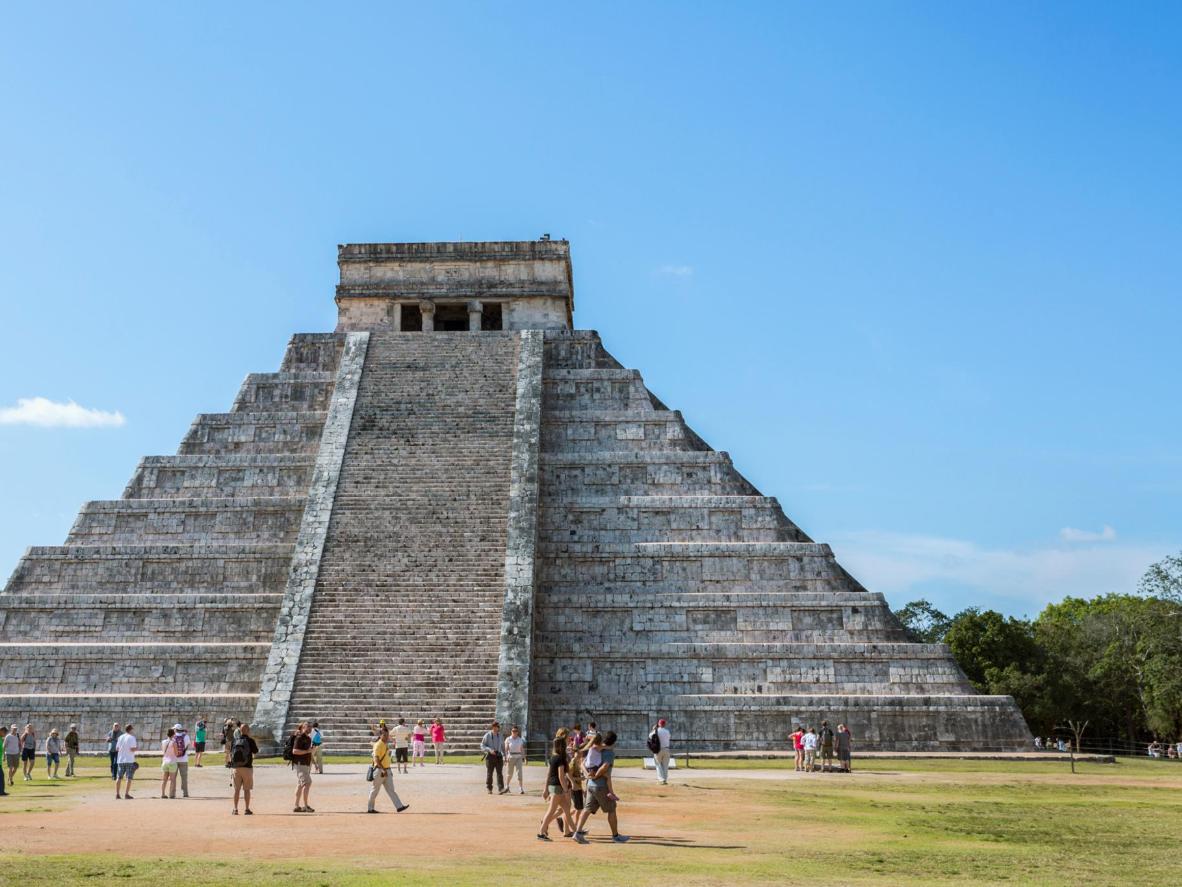
El Castillo pyramid, Valladolid, Mexico

El Castillo pyramid, Valladolid, Mexico

At its peak, the ancient Mayan city of Chichén Itzá was home to 30,000 people. Today its ruins draw about 1.2 million visitors per year. In the center of the complex sits El Castillo pyramid, a towering limestone tribute to the god Kukulkán. During the spring and autumn equinoxes, crowds gather to see the sun cast a shadow illusion of a snake creeping down the pyramid's steps. The nearby city of Valladolid makes for a handy base to explore the ancient city. Cool off at the Hotel Mesón del Marqués, a 17th-century mansion with a garden and pool.

Mexico City, Mexico

The ruins of the Aztec Templo Mayor sit alongside Mexico City Cathedral

The ruins of the Aztec Templo Mayor sit alongside Mexico City Cathedral

This modern megacity was built on top of the conquered Aztec capital, Tenochtitlan. Its pre-Hispanic past was all but forgotten until the 1970s, when excavations unearthed the ruins of the main temple next to the city's Zócalo Square. Hotel Histórico Central is just a few blocks from the Templo Mayor Museum. A short drive north of Mexico City lies Teotihuacán, which the Aztecs dubbed the “birthplace of the gods.” Visitors can still scale its Sun and Moon Pyramids and walk the Avenue of the Dead that links them.

Mérida, Mexico

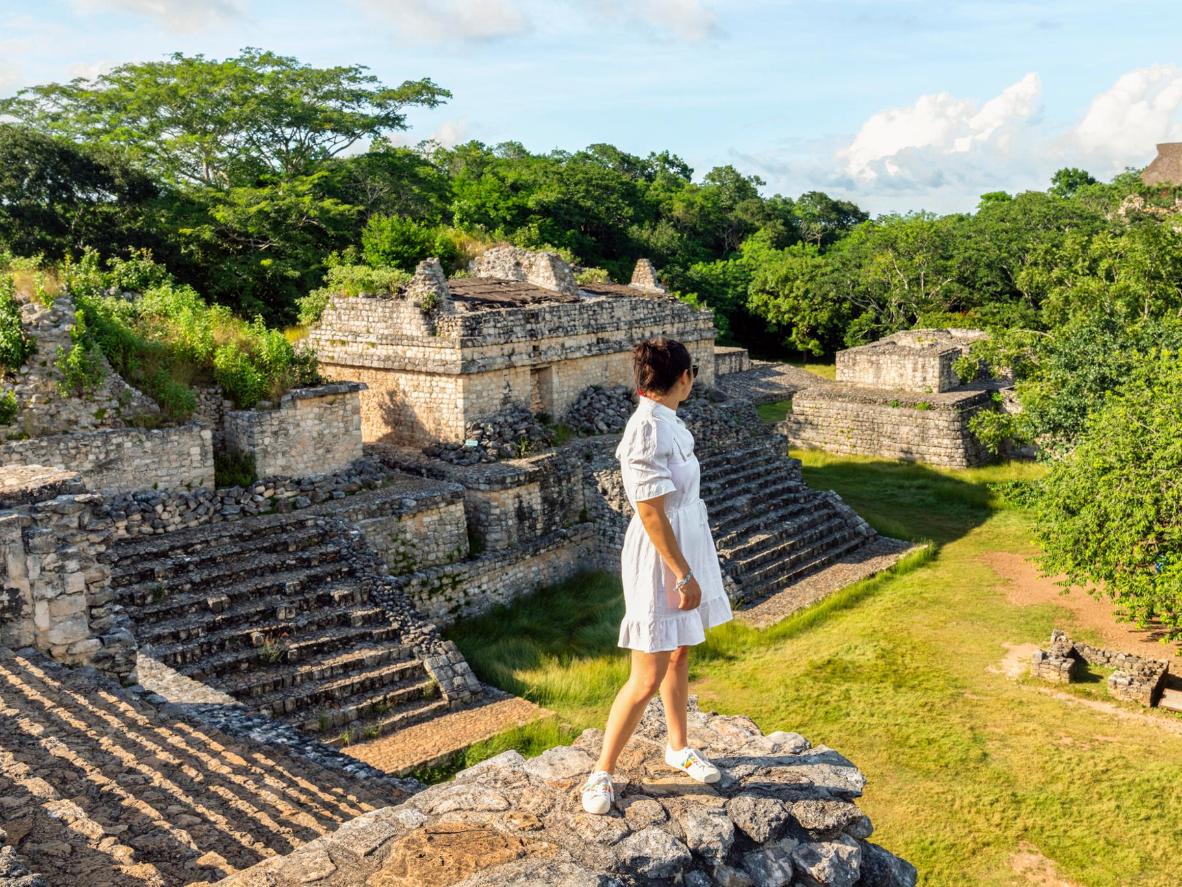
Uxmal’s ancient ruins, Mérida, Mexico

Uxmal’s ancient ruins, Mérida, Mexico

The colonial city of Mérida is the Yucatán region’s cultural capital. In its northern suburbs, the Gran Museo del Mundo Maya houses a vast collection of Mayan art, crafts, and historical relics. An hour’s drive south is the Uxmal archaeological site, a huge complex of smooth-faced pyramids and ornately-carved temples – many of which you can still climb. After a day exploring the ruins, the shady courtyards and outdoor pool at Hotel Caribe Mérida Yucatán provide a break from the heat.

Oaxaca, Mexico

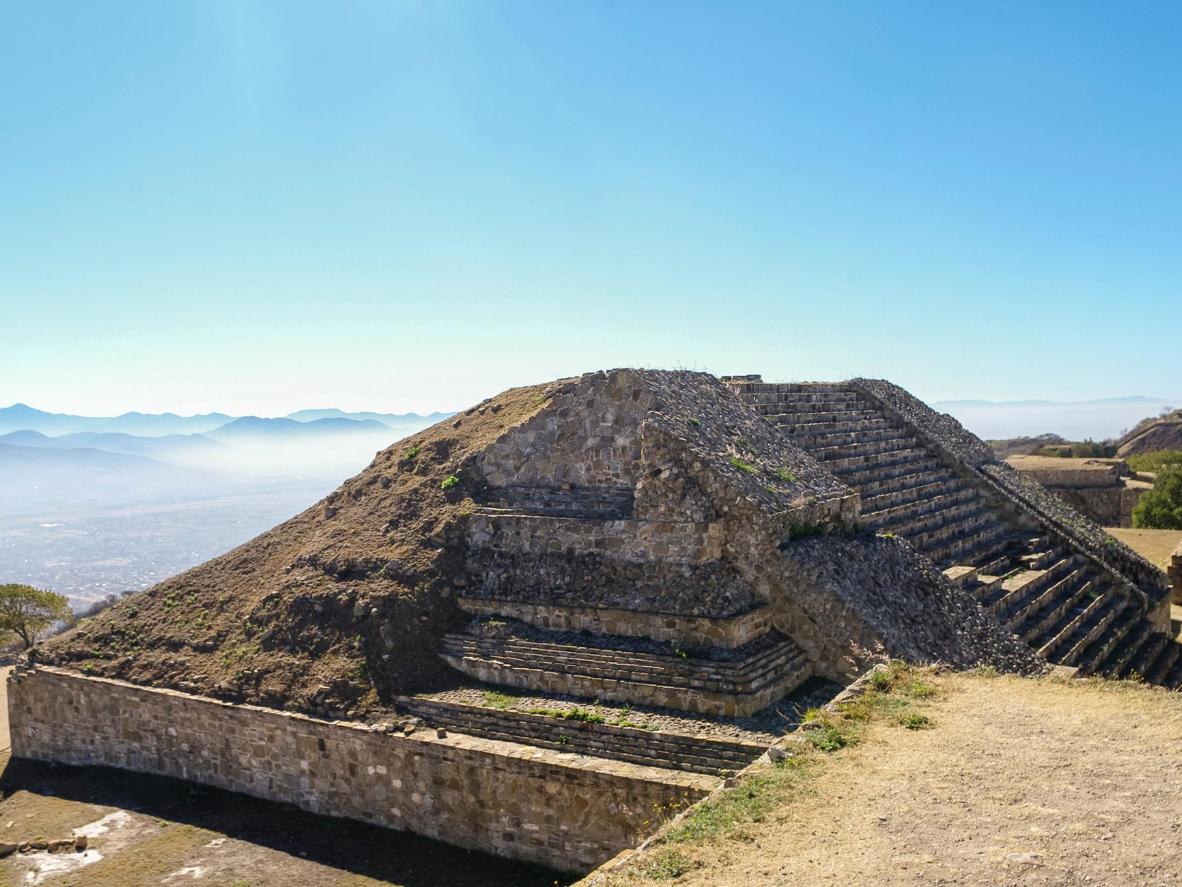
Monte Alban, Oaxaca, Mexico

Monte Alban, Oaxaca, Mexico

Set high on a hilltop plateau, Monte Albán was once the capital of the Zapotec empire. This ancient civilization ruled over the Valley of Oaxaca, filling the fortified city with stepped pyramids, ball courts, and hundreds of contorted, stone figures known as “danzantes.” Down on the parched valley floor, the archaeological site of Mitla was the region's spiritual center. Look out for eagles circling overhead as you explore its low, angular temples and geometric designs. Back in town, sleep in a converted 15th-century building, Quinta Real Oaxaca.

Thứ Hai, 21 tháng 2, 2022

5 Amazing Rooftop Pools in Rio

5 Amazing Rooftop Pools in Rio

Rio de Janeiro is a sprawling, tropical metropolis. That’s why rooftop pools are the perfect place to simultaneously take in stunning city views and escape the heat.

Take our advice and be a Booker at one of the city’s five most extraordinary rooftop swimming spots.

Hotel Santa Teresa

Unique inner-city calm in this boutique hotel’s rooftop garden

Lining a sleek swimming pool are striped lounge chairs that are perfect for kicking back and soaking up the urban tranquility of this boutique hotel’s rooftop garden. It sits on a hill above Santa Teresa—the tree-filled, bohemian neighborhood—offering incredible views across the city. The Rio skyline is even more striking at sundown, when the city in the darkness below lights up, and up the seating area fills up with guests sipping Negronis. If a stay here seems a little pricey, don’t worry – the hotel’s chic downstairs Bar dos Descasados is open to everyone. Bookers come from all over the city to sample its mango and tangerine caipirinhas while watching some live Brazilian music.

Hotel Fasano

The breathtaking views of the Morro Dois Irmãos and Ipanema Beach from Hotel Fasano's rooftop pool

The breathtaking views of the Morro Dois Irmãos and Ipanema Beach from Hotel Fasano's rooftop pool

Hotel Fasano sits alongside Ipanema Beach, right in the middle of some of Rio’s most prized real estate.

On the eighth floor, you’ll find the crowning jewel of this Philippe Starck-designed hotel – the stunning, guest-only rooftop pool. It’s as exclusive as they come, frequented by both travelers and locals, who often book suites just to get access to the hotel’s parties. Bookers can enjoy the top-notch service and sip a cocktail while taking in the view, with the peaks of Morro Dois Irmãos perfectly framing the beach below.

PortoBay Rio International

A minimalist pool 20 floors above Rio’s most stylish neighborhood

A minimalist pool 20 floors above Rio’s most stylish neighborhood

The minimalist, square swimming pool at this luxurious Copacabana hotel towers 20 above one of Rio’s most fashion-forward neighborhoods. The pool might not be deep enough for a heart-pumping swim, but it’s guaranteed to be refreshing after a day out in the Brazilian heat. Bookers can kick back on a sun chair and grab a caipirinha to take in views of the favelas, Christ the Redeemer, and Sugarloaf Mountain.

Hilton Barra Rio de Janeiro

Pastel sunsets through this pool's state-of-the-art sunroof

Pastel sunsets through this pool's state-of-the-art sunroof

The Hilton Barra’s mosaiced, infinity rooftop pool is breathtaking. Its lean, rectangular shape and bold lines match the hotel’s modern architectural design, with grey columns supporting a state-of-the-art sunroof. Bookers can treat themselves to a cocktail while gazing out over the mountains and the nearby Jacarepagua Lagoon.

Miramar Hotel by Windsor

Swimming and sunbathing in the Sugarloaf Mountain silhouette

Swimming and sunbathing in the Sugarloaf Mountain silhouette

The glass border of this hotel’s rooftop pool is practically invisible, blending its ice-blue waters beautifully with the sea and sky beyond. Just after sunset, the sky’s pastel pinks and oranges reflect off the pool’s surface, as fluffy clouds drape the silhouette of Sugarloaf Mountain. Located on Avenue Atlantica at Copacabana beach, Bookers are promised easy access to all of Rio’s main attractions.

Thứ Bảy, 31 tháng 7, 2021

Unusual snowfall in Brazil after more than half a century

Unusual snowfall in Brazil after more than half a century

After 64 years since 1957, people in Brazil have witnessed an unusual weather phenomenon, when the temperature dropped, causing snow to fall and cover the streets.

You may also like:

Snow and ice cover tree branches at dawn in Sao Joaquim, Brazil on July 28. An unusually intense cold at night caused heavy snowfall in southern Brazil. The last time Brazil saw a blizzard was in 1957, when up to 1.3 m of snow was recorded in the state of Santa Catarina.
Snow covers the road in Sao Joaquim on July 29. According to information from the weather service Climatempo, at least 43 cities in Brazil reported recordings of snow or ice by the end of July 28.

A man plays in the snow at a farm in the countryside of Sao Joaquim on July 29. In a video broadcast on local television, people in the city of Bom Jesus in the state of Rio Grande do Sul also set up snowmen on the square and played snowball games.
Temperatures are expected to continue to drop and more snow is possible. The Brazilian Meteorological Institute said the low temperatures will last until early August. Frost could appear in the states of Mato Grosso do Sul, Sao Paulo, Minas Gerais and Goias on July 30 (local time).
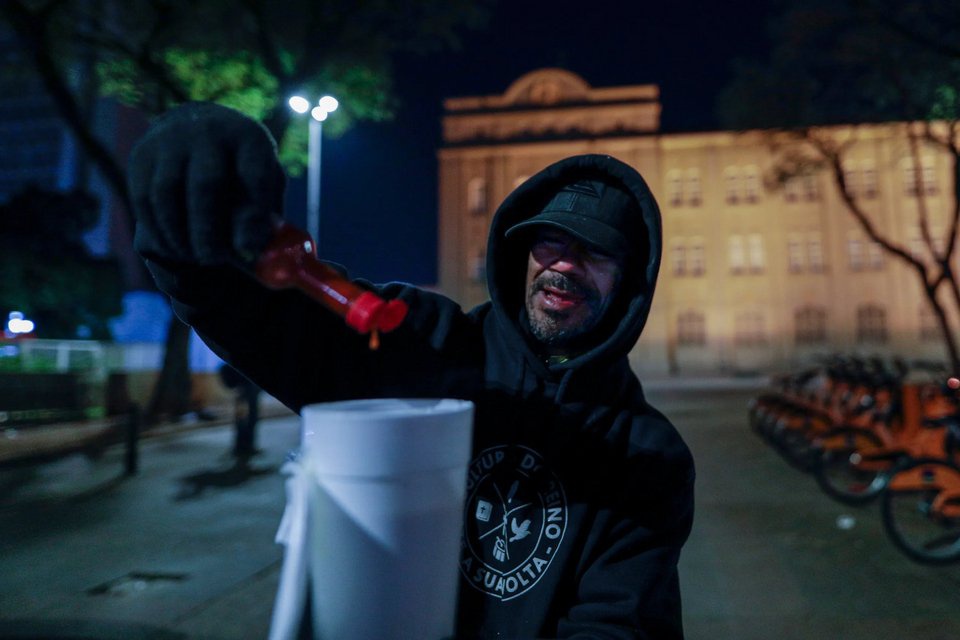
Rodrigo, a 14-year homeless, adds hot chili sauce to a bowl of soup on a cold night in Sao Paulo on July 29. Falling temperatures and cold weather have forced many homeless people in Brazil to seek shelter and warm food to stay safe.
Homeless people lie on mattresses placed by the government inside a metro station in the most populous state, Sao Paulo, in the early morning hours of July 30. The state government on July 29 donated 7,500 blankets and 1,000 sleeping bags to organizations helping the homeless, turning a subway station into a shelter that can accommodate 400 people.
Homeless people in Sao Paulo light fires to keep warm. Maria Madalena Dutra was among those shivering through the night on the streets of Sao Paulo as she slept on a blanket and a tarp. "Last night, it was so cold that we lit lighters in our hands to keep warm, but it didn't help," Dutra said. "Temperature isn't the only problem. It's horrible when it's cold and windy and rainy at the same time."
Homeless people huddled in the cold, eating a hot meal donated by a church in Sao Paulo early on July 30.
A man warms himself by a fire in the streets of Sao Paulo.

Thứ Sáu, 30 tháng 7, 2021

17 things about Cuba you may not know

17 things about Cuba you may not know

Cuba is an island nation located in the Caribbean area. Despite of its humility size, Cuba has a characteristic culture and will impress anyone who visits it. 17 things following here will unveil something that maybe you are still unknown.

You may also like:

Cuba is on everybody's lips lately. The country has seen huge tourism booms since the improvement of US-Cuba relations and relaxed travel laws. If it's on your wishlist, here are a few things that might surprise you about this beguiling country.

It has a huge population


Cuba is the most populated country in the Caribbean, with more than 11 million residents.

One country, two currencies


That’s right, Cuba has not one but two currencies. The Cuban peso (CUP) and the Cuban convertible peso (CUC) are both legal tender on the island, with the latter worth 25 times as much as the CUP. While most Cubans are paid in CUP, nearly all goods are priced in CUC.

The island has a nickname


Cuba is often referred to as El Caiman or El Cocodrilo (Spanish for alligator) on account of its shape when seen from above.

It's the home of rum


Bacardi, the spirit maker of rum, Dewar’s Scotch and Grey Vodka, was actually founded in Cuba. However, the brand moved its operations to Puerto Rico after Fidel Castro came to power.

Hemingway found his inspiration there


Ernest Hemingway wrote For Whom The Bell Tolls and The Old Man and the Sea while he lived in Cuba. He often stayed at the Hotel Ambos Mundos in La Habana (pictured).

There was no Christmas in Cuba


Christmas did not become an official holiday in Cuba until 1997. This was introduced by former leader Fidel Castro as a gesture of goodwill in honour of Pope John Paul II’s visit.

Cuba breeds doctors


There are so many doctors in Cuba they’re often sent to other countries that have a shortage. The country has 90,000 of them to serve its population of 11 million. That's eight for every 1,000 citizens – which according to the World Bank is more than double the rate in the US (2.5) and the UK (2.7).

There's top notch healthcare


In Cuba healthcare is free and seen as a fundamental human right, guaranteed by the state. Despite spending a fraction of what the United States spends on healthcare (the World Bank reports Cuba spends $431 per head per year compared with $8,553 in the US) Cuba has a lower infant mortality rate than the US and a similar life expectancy.

Hitchhiking is easy and legal


Forget buses, lots of Cubans engage in the nationalised hitchhiking system which came about in the 1990s. At the time buses were scarce and it was illegal to buy cars, so the government made it mandatory for government vehicles to pick up hitchhikers.

There are lots of cool vintage cars


One of Cuba’s most distinctive anachronisms has always been streets full of classic cars like Chevrolets, Buicks and Fords. Why? Because up until 2014 it was forbidden to purchase cars manufactured abroad.


Monopoly has been banned


It’s said that when Fidel Castro seized power in Cuba, he immediately ordered all sets of the game Monopoly to be destroyed.

They burn dolls at New Year


On New Year’s Eve, it’s tradition for Cubans to burn dolls in order to symbolise forgetting bad times and looking forward to new and good times during the New Year.

It's all about ballet and baseball


Two of the nation’s biggest passions are baseball and ballet. The latter is funded by the government, which pays for ballet training and subsidies tickets to performances.

Some soft drinks are banned


Cuba is one of two countries where the sale of Coca-Cola is prohibited. Although it was one of the first countries outside the US to receive its own bottling plant in 1906, when the Castro government began seizing private companies in the 1960s Coke made a swift exit, with not a drop being served in the country since.

Unusual etiquette


Blowing your nose in public in Cuba is considered extremely rude.

Cubans aren't having enough kids


The country has one of the lowest birth rates in the Western Hemisphere. Falling dramatically since the 1970s, in 2013 only 9.51 babies per 1,000 Cubans were born.

Taking pictures can be illegal


While reports vary on whether it’s actually illegal or not, taking photos of anything associated with the police or military is certainly frowned upon and could result in you losing your camera.

Thứ Sáu, 23 tháng 10, 2020

 Mystery of a giant cat draw over 2,000 years old in the desert

Mystery of a giant cat draw over 2,000 years old in the desert

In the Nazca Desert, an archeology team from Peru has discovered a giant drawing dating back to about 200 BC.

You may also like:

Although appearing on the slopes of a mountain in the Nazca Desert for more than 2,000 years, recently, a team of archaeologists in Peru has discovered a giant cat-shaped drawing.

Giant cat figure has just been discovered on the slopes of the Nazca desert

It is known that the figure is 120 meters long, dating back to about 200 BC. According to archaeologist Jhonny Isla, this drawing was found as the group was improving access to a attraction that allowed visitors to view giant drawings on the Peruvian desert.

In the Paracas culture, the cat symbol appeared on many ceramics, textiles ... Paracas are also believed to be the creators of the giant drawing on the Nazca Desert. Viewed from above, most of these figures depict flora and fauna.

Before that, many mysterious drawings appeared in the Nazca desert.

Earlier in November 2019, the archeological team also discovered more than 140 Nazca lines in the desert in Peru, determined to be about 2,100 years old. This discovery is made possible by research that lasted for 15 years by applying current technology of archeology group from Yamagata University (Japan).

The mysterious Nazca deserts draws were first photographed around the 1920s when commercial aircraft flew over the place. At that time, the guests on the plane said they saw "primitive tracts" on the ground below.

Up to now, the Paracas is also believed to be the creators of the giant drawing.

Next, the Nazca line was discovered by archaeologists in 1927, later recognized by UNESCO as a World Heritage Site.

In fact, the giant drawings that existed on the Nazca desert for thousands of years are still a mystery to archaeologists. No one can be sure why they were created, why they are so large and last so long.

As one of the driest regions in the world, the drawings on the desert is not covered by sand.

According to the original assessment, the Nazca Desert was originally one of the driest regions in the world, with a temperature of about 25 degrees Celsius. Because the desert had little wind, the giant drawings were not covered by sand and soil, and still exists today.

Thứ Hai, 12 tháng 10, 2020

 Strangely, a tribe likes to tattoo themselves for beauty

Strangely, a tribe likes to tattoo themselves for beauty

The Embera people, who live in southern Panama, have a unique beauty method that is tattooed entirely their body from jagua squid.

You may also like:

Most people in the Embera tribe have tattoos on their bodies. Adults prefer geometric tattoos such as lines and triangles, while children can tattoo a snake, a butterfly.

The ink used to create these tattoos is from the jagua fruit. Because this tree is very tall, picking jagua for squid belongs to men, while squid preparation is done by women.

Jaguar is native to South America, Panama, and southern Mexico. It is abundant in the tropical forests of South America and consumed by indigenous tribes.

When ripe, the fruit can be eaten and served as a drink. Traditionally, the unripe fruit was used as a coating for tribal ceremonies.

The juice from the unripe jaguar fruit has consistency. The women will add essential oils, additives to turn it into the gel used for the art of tattooing.

The Embera use long bamboo sticks to draw tattoos on their bodies. Picture in dark green or indigo. It can be stored on the body for 1-2 weeks.

It is known that the most important reason that the Embera tattoo is because this is the tradition of their ancestors. The Embera ancestors passed down the technique of making ink from jagua and tattooing over the generations. They take pride in possessing beautiful tattoos and unique inking techniques.

In the past, only a magician could tattoo people. They use tattoos in their wellness praying rituals. In addition, the Embera used this ink to disguise themselves in the forest during conflicts with other tribes.

These days, they use this ink as a sunscreen, shampoo, or a "weapon" to repel insects.

The Embera tribe is native to the Darien region of Panama and the Choco region in Colombia. Currently, there are about 30,000 Embera living in Panama.

However, because the Darien region is relatively remote, 6-10 hours from Panama City, most of the tribal people have moved to live near Chagres National Park.

Since hunting is not allowed, the Embera depend on tourism. Tourism also encourages people here to maintain their own traditions, culture, and language.

Thứ Bảy, 26 tháng 9, 2020

 Rio de Janeiro people waiting for the bleakest carnival season of the century

Rio de Janeiro people waiting for the bleakest carnival season of the century

The residents of Rio de Janeiro did not see hope for the carnival festival early next year amid rising infections and Brazil remains the world's third-largest pandemic hotspot.

You may also like:

On September 24, the Federation of the Samba Dance Schools of Rio de Janeiro City (LIESA) announced that the carnival masquerade would not take place due to the Covid-19 pandemic. This traditional event usually takes place every February. Photo: AP.

“When the festival isn't held, the samba dance schools or the event organizers are just a few handfuls affected. In Brazil, this event is an opportunity to make money for many working-class people, ”said Mr. Luiz Simas, historian of carnival festival. Photo: AP.

Rio de Janeiro city hall (capital of the state of the same name) has yet to issue an official statement about the postponement of the festival. However, the tourism promotion agencies on September 17 confirmed that the city would not allow large gatherings without the Covid-19 vaccine. Photo: AP.

The carnival often brings together thousands of samba dancers in colorful and elaborate costumes. They can dance non-stop around the Sambadrome arena to impress the audience and the judges. Photo: AP.

In the wake of the epidemic, dance schools were unable to continue making costumes or dancing rehearsals. Many dancers are also unemployed, have to make a living on small contracts. Photo: AP.

Diogo Jesus is known as "dance master" at Mocidade dance school. Now, he must count on single shows to pay his rent. He drove an Uber and made masks for sale at the fair. Photo: AP.

“This is a shock. When realizing the pessimistic situation, many people even fell ill or suffered from depression, ”said Jesus. "The carnival is our life." Photo: AP.

Before the Covid-19 pandemic, the carnival was delayed only once in 1912, when former Foreign Minister José Paranhos died. Mr. Paranhos is a highly respected figure and the dense activities of tribute to him have caused the festival to be delayed that year. Even during World War II, dancers were not discouraged and maintained this traditional event. Photo: AP.

The decision to postpone the carnival will deprive a vast income of the tourism industry of Rio de Janeiro. Industry experts estimate this year's festival attracts 2.1 million visitors and $ 725 million. Photo: AP.

Drum teacher Laudo Neto shared that his students are not in the mood to study. “The masquerade can only take place when the world moves like it did before a pandemic. I don't see hope in 2021, ”said Neto. Photo: AP.