Hiển thị các bài đăng có nhãn Destination. Hiển thị tất cả bài đăng

Thứ Ba, 8 tháng 3, 2022

The best of Croatia’s natural beauty

The best of Croatia’s natural beauty

Stretching between the huge Velebit mountains and the pebbly Dalmatian coast, Croatia’s landscape is as diverse as it is dramatic. To free up as much time as possible to take in leafy national parks, rocky terrain, and saltwater lakes, consider booking your whole trip with flexible flights, accommodations, and a scheduled taxi from the airport before you leave home.

To help with your planning, we found some of the best places to experience Croatia’s natural beauty, as selected by global travelers.

Zlatni Rat Beach, Split-Dalmatia County

The triangular peninsula at Zlatni Rat Beach is nicknamed the “Golden Horn”

Zlatni Rat’s pointy peninsula of fine sand makes it Croatia’s most recognizable beach. Jutting out from Brač Island’s pine-forested coast, the “Golden Horn” attracts sunbathers, snorkelers, and surfers. The headland’s natural shelter makes windsurfing especially popular. For shimmering Adriatic scenery, you can climb up the Vidova Gora mountain and survey the beach’s angular shape from above. After a day outdoors, the seafront bar at Zlatni Rat Beach Hotel provides refreshing relief.

Blue and Red Lakes, Split-Dalmatia County
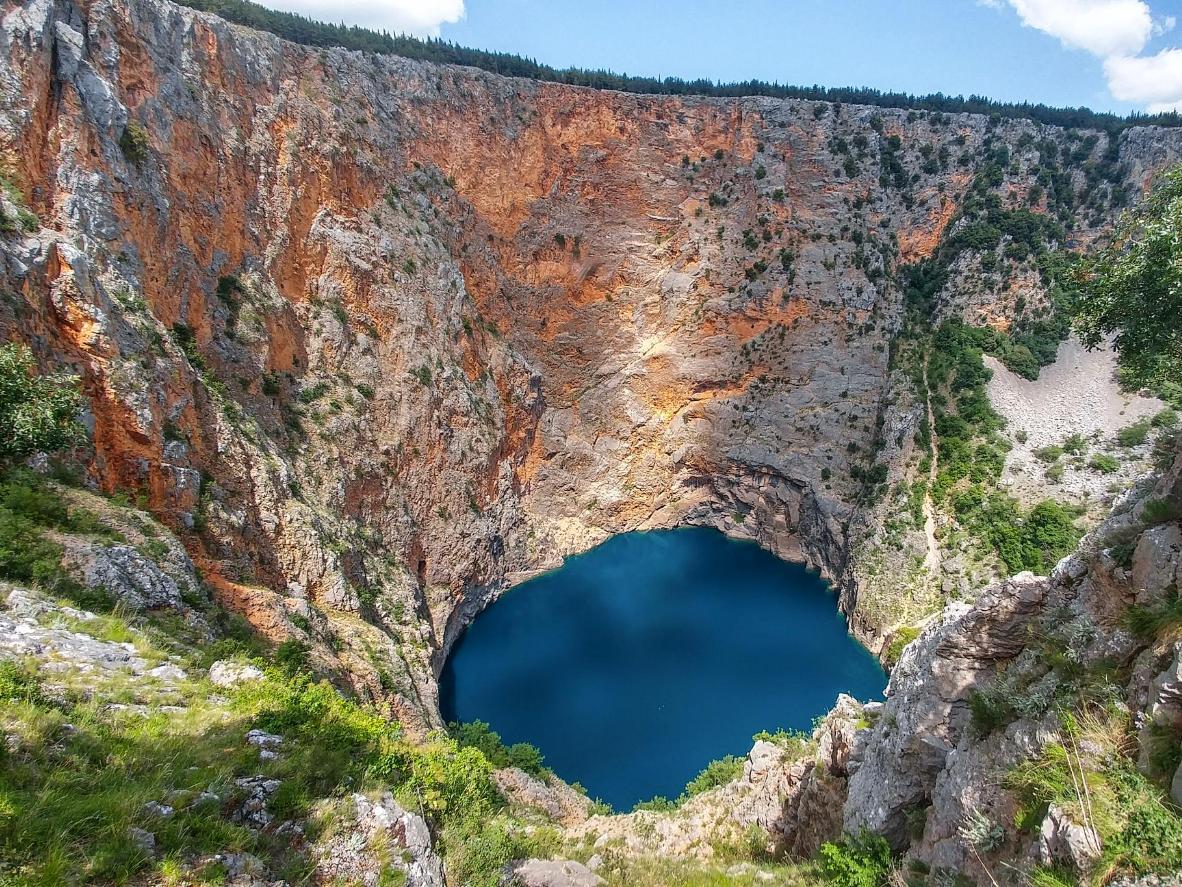
The breathtaking Red Lake nestles inside Europe’s largest collapsed sinkhole

The breathtaking Red Lake nestles inside Europe’s largest collapsed sinkhole

Formed by collapsed caves, the huge karst sinkholes on the edge of Imotski village will leave you in awe. During spring, melting snow fills the 720-foot-deep Blue Lake, creating a stunning cyan surface, while in the summer you can hike down to the dried bed and watch locals play football. Then there’s the Red Lake, whose corroded cliffs stretch 850 feet above—and below—the water. Before visiting the lakes, enjoy views of the Biokovo mountains with some smoked pršut ham at Hotel Venezia Imotski.

Skradinski Buk Waterfall, Šibenik-Knin County
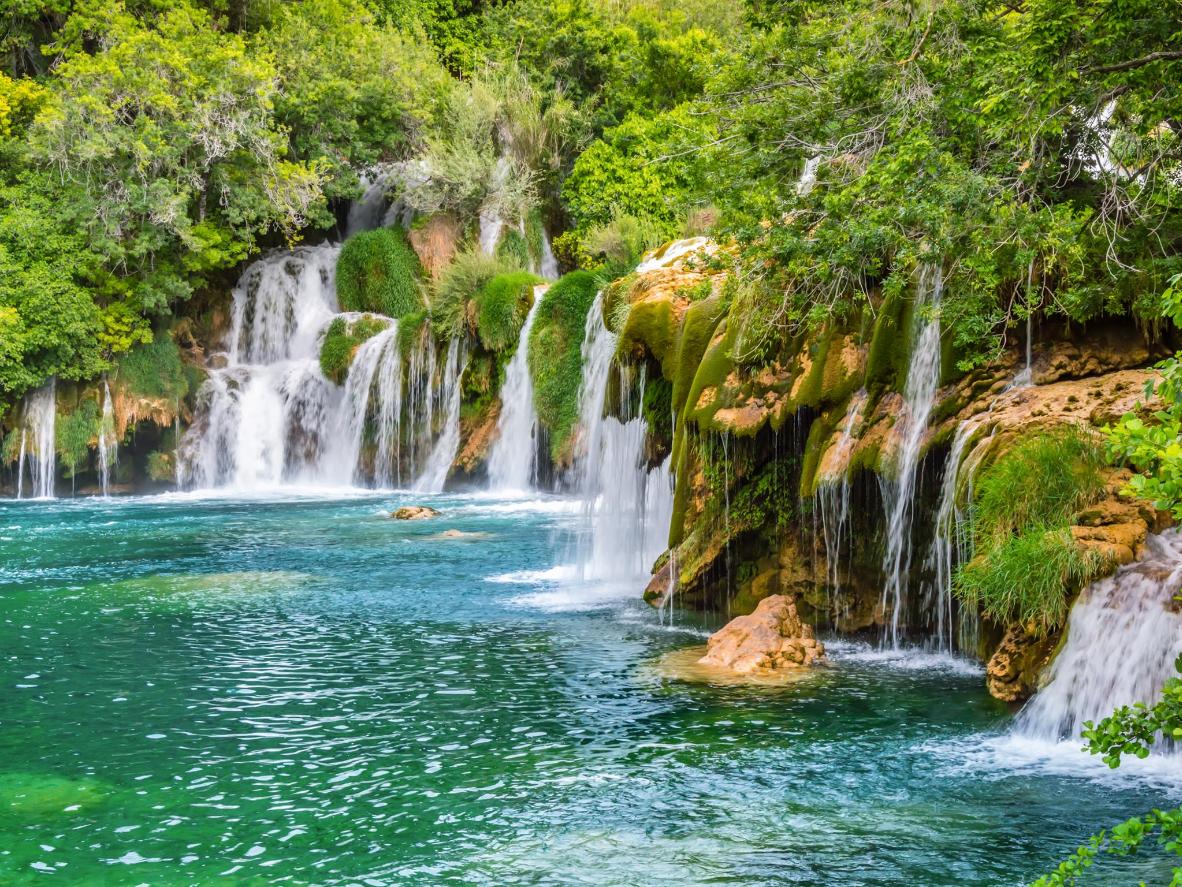
Skradinski Buk Waterfall is the showpiece of Krka National Park

Skradinski Buk Waterfall is the showpiece of Krka National Park

In the vast and verdant Krka National Park, the teal Skradinski Buk Waterfall is the star attraction. Admire its cascades, limestone terraces, and mini lakes from wooden walkways, or take a guided boat tour to hear how Skradinski Buk once powered Europe’s first hydro-electric station. You can even change into your swimwear and wade in to experience the falls’ majesty up close. At Rooms Ive in nearby Lozovac, cap off the day with a glass of wine from the property’s vineyard.

Blue Cave, Split-Dalmatia County
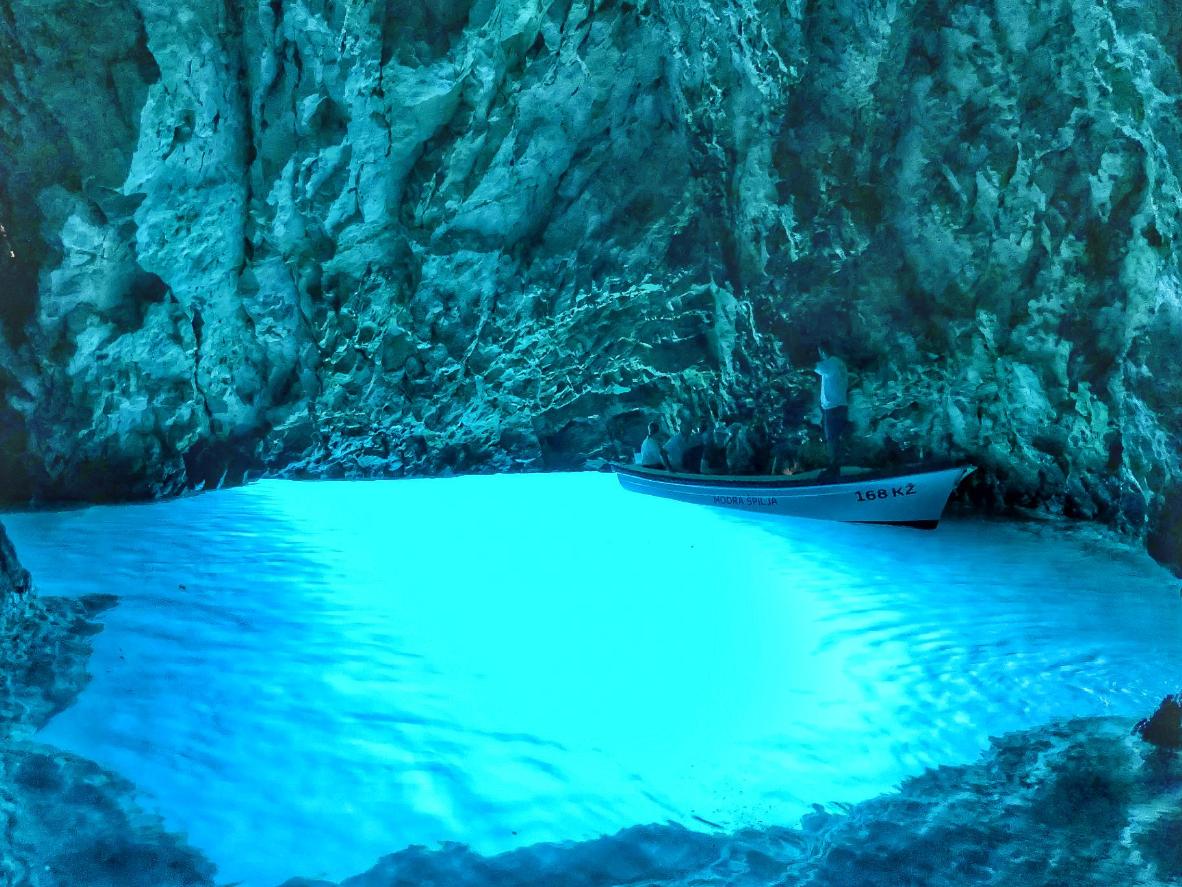
The otherworldly hues of the Blue Cave leave visitors spellbound

The otherworldly hues of the Blue Cave leave visitors spellbound

There are many grottoes carved into Biševo Island’s limestone coast, but the 80-foot-long Blue Cave is truly special. When sunlight hits the water below its natural chamber, the grotto glows in celestial aquamarine and electric blue, turning everything beneath the surface silver and pink. To bask there in peace, hop on the small boats that depart Mezuporat Bay first thing in the morning. The air-conditioned Apartments Kastelani is 15 minutes away, on neighboring Vis Island.

Plitvice Lakes, Lika-Senj County
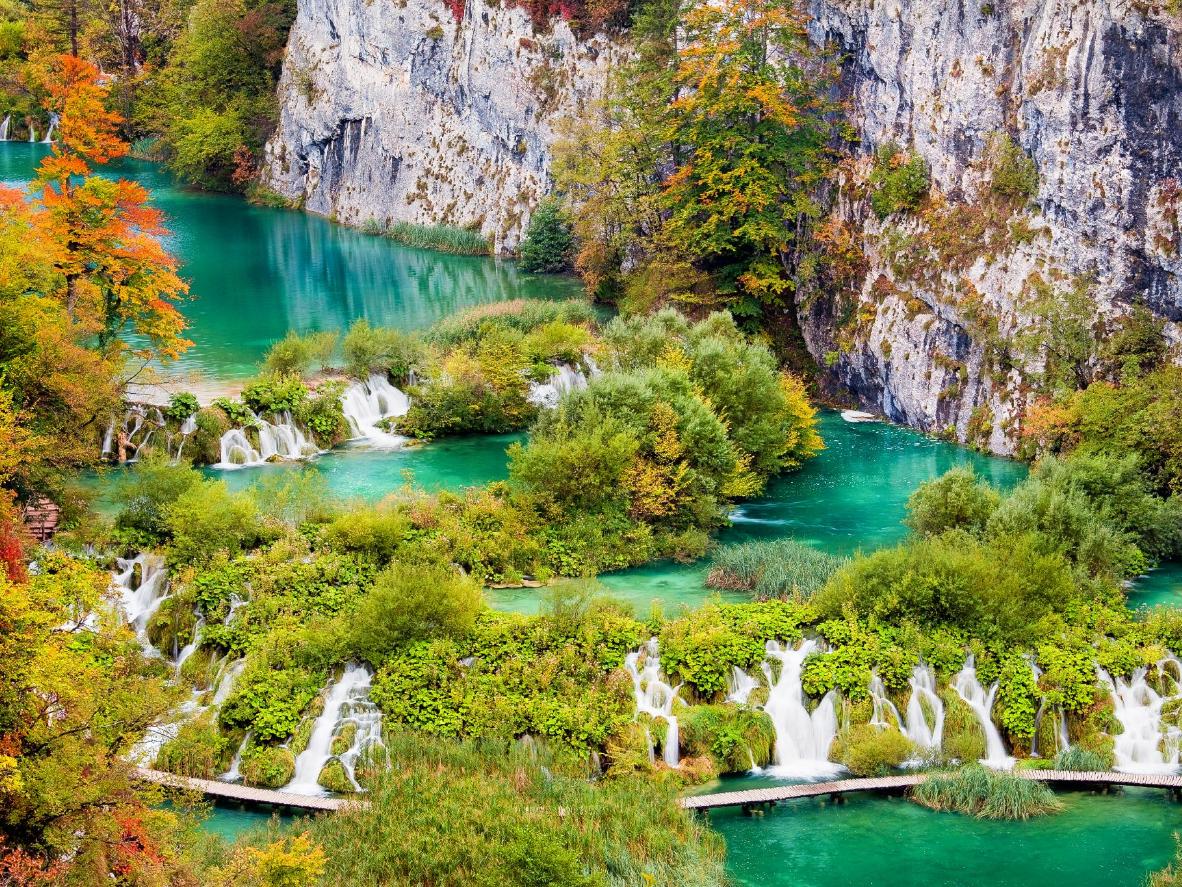
Plitvice Lakes’ pools and falls descend downstream for five miles

Plitvice Lakes’ pools and falls descend downstream for five miles

Croatia’s most famous waterway is right out of a fairy tale. The magical Plitvice Lakes comprise 16 basins and 90 waterfalls that tumble down stepped deposits of moss-clad tufa rock. Waters flow at full tilt during spring, but you can venture onto the larger Gavanovac and Kaluđerovac lakes in a rowboat in the summer. Even in low season, the autumnal tones and icy cascades are worth the venture. Right next door, Hotel Plitvice has rooms offering views of the park.

Northern Velebit National Park, Lika-Senj County
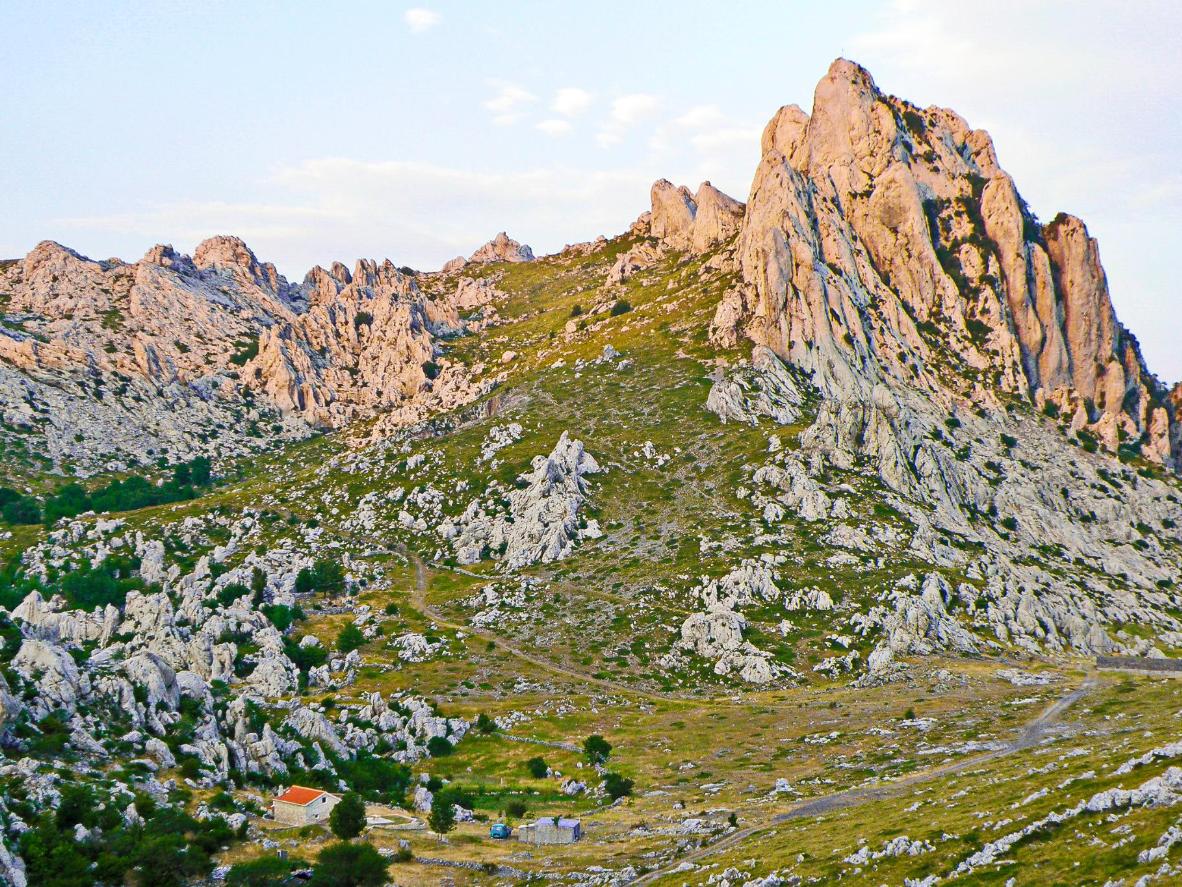
Fascinating rock formations dominate the Northern Velebit landscape

Fascinating rock formations dominate the Northern Velebit landscape

Famous for its rocky terrain and rich biodiversity, Northern Velebit National Park encompasses a huge swathe of Croatia’s largest mountain range. Along its winding trails, you’ll come across jagged limestone grooves, purple blankets of Siberian iris, and ancient grasslands. For sweeping vistas of valleys, peaks, and coastlines, head up to the Zavižan weather station beneath the mile-high Vučjak summit. Stay close to the village of Jablanac for easy access to the incredible natural surroundings.

Mljet National Park, Dubrovnik-Neretva County
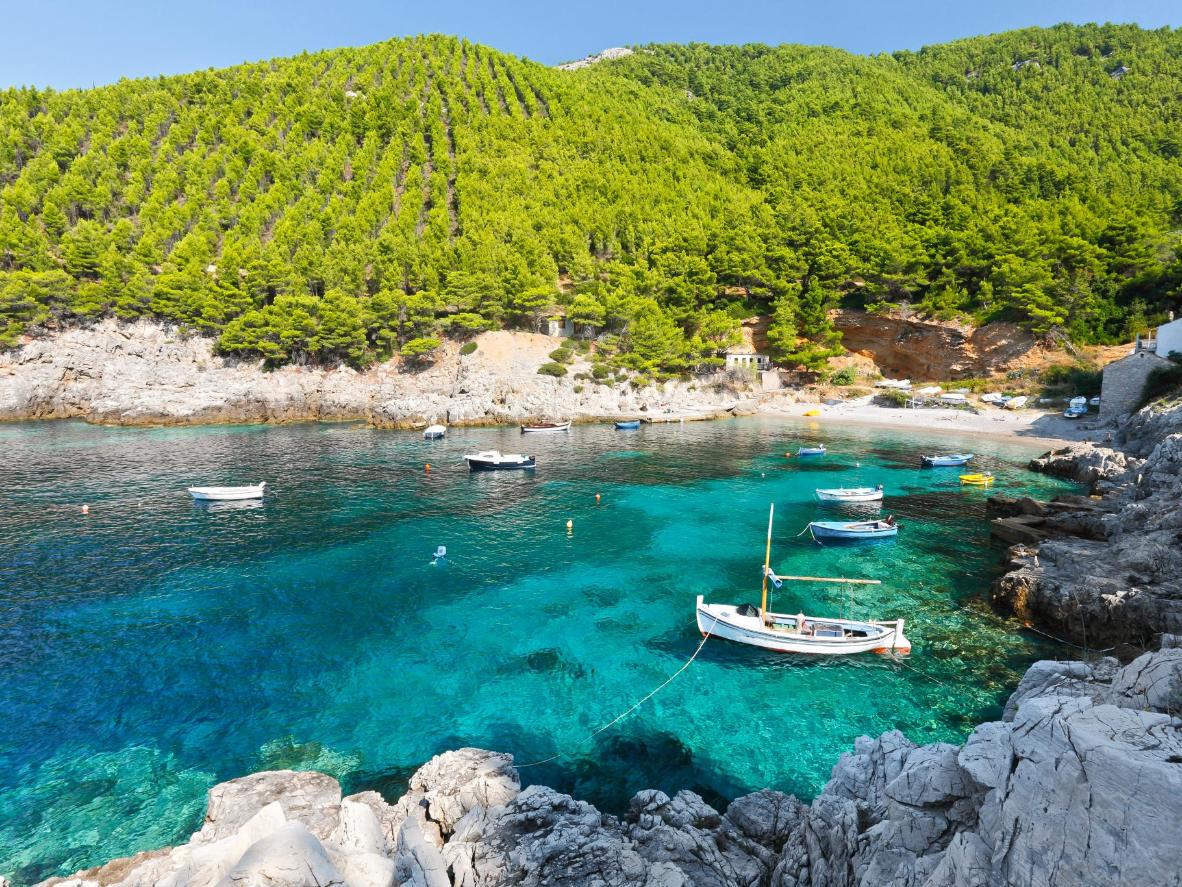
The charming village of Polače is your gateway to Mljet National Park

The charming village of Polače is your gateway to Mljet National Park

Only a short catamaran ride from Dubrovnik, the thickly forested Mljet Island is a lush escape. Mljet National Park engulfs the north-western part, where hiking and bike trails circle two glistening saltwater lakes. Rent a kayak and paddle out to the pretty 12th-century Benedictine monastery on Veliko Jezero, then cool off in the lagoon-like Malo Jezero. At Villa Radulj, you can sample fresh seafood and vivid seascapes just a 5-minute drive from the park’s eastern edge.

Galešnjak Island, Zadar County
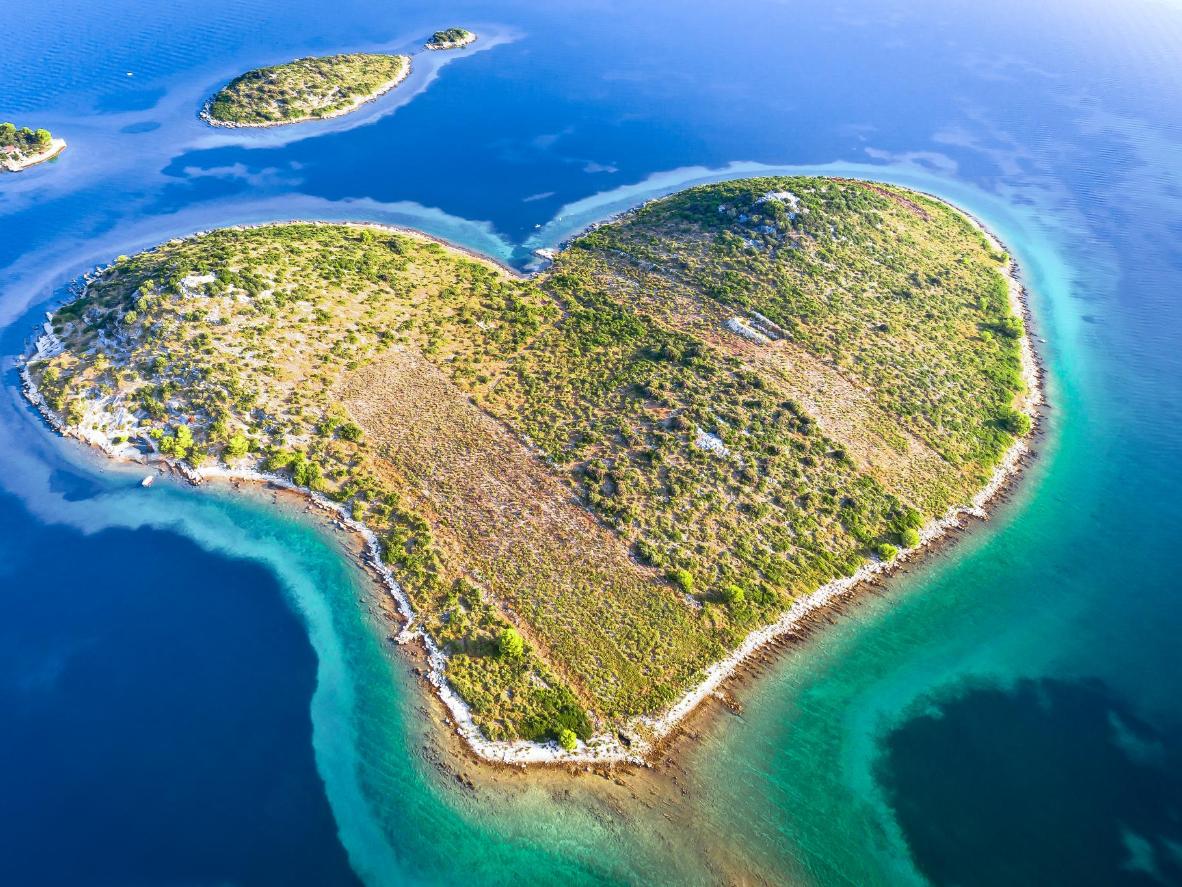
Galešnjak is a much-loved, pristine island in the Zadar archipelago

Galešnjak is a much-loved, pristine island in the Zadar archipelago

Nicknamed “Lovers Island,” Galešnjak’s heart-shaped outline was first noted by Napoleon’s imperial cartographer in 1806. Today, its secluded pebble beaches and turquoise waters entice travelling couples to take desert-island dips and romantic picnics. If you dare to pop the question, the only onlookers will be wild rabbits skipping through rows of olive and fig trees. Set the mood with flower-strewn beds, towel origami, and island views at Apartments Katarina in nearby Sveti Petar.

Thứ Hai, 7 tháng 3, 2022

The ultimate Santorini summer home escapes

The ultimate Santorini summer home escapes

 Fully immerse yourself in Greek island life in an idyllic villa on the island of Santorini, where you can swim in a cobalt-blue sea, drive around tranquil whitewashed villages to buy your morning Spanakopita (spinach and feta pastry), and sunbathe in blazing sunshine when it's safe to do so. Your only challenge is finding the best vantage point to take in this island's dreamy vistas.

Continue reading for Santorini’s highest-rated flexible vacation homes, according to global travelers.

Ikia Kriton


Have a glass of wine with a surreal Aegean Sea backdrop at Ikia Kriton

This old stone house is built into the cliffs on the edge of Santorini’s caldera, a crater that was partially submerged by the Aegean Sea after a volcanic eruption about 3,600 years ago. Views out onto this half-moon-shaped bay are highly sought after, and hundreds of thousands of visitors come each year to witness the soulful sunsets over whitewashed villages, a cobalt blue-sea, and maroon cliffs. The unblemished panorama of the island from this house’s broad terrace is a valuable asset and a heavenly spot for an early morning coffee or a night cap brought to you by welcoming hosts Kriton and Eirini, a mother and son duo.

Anemi House & Villas

The infinitely-instagrammable color palette of Anemi House & Villas

The infinitely-instagrammable color palette of Anemi House & Villas

A traditional Santorini cave house painted pink, lilac, and blue, Anemi House & Villas is as photogenic as the caldera itself. It’s laid out like a rabbit warren, with gray stone stairs and private pockets of terrace punctuated by a plunge pool. Shaded by olive and palm trees beside overflowing flower pots, you’ll have a wide choice of places to enjoy a glass of wine in the evening sun. The house has everything you could ever want on vacation: An attentive but unobtrusive owner, Dimitris, beautiful monochrome suites varying from bright white to royal blue and hot pink, 360-degree views of the island from the rooftop, outdoor hot tubs, and lots of local markets.

Azalea Houses

Azalea is an 18th-century winemaker's house with peach-colored brick walls

Azalea is an 18th-century winemaker's house with peach-colored brick walls

A restored, 18th-century winemaker’s house with mud brick walls, Azalea Houses is authentically and traditionally Greek. At the same time, it’s the height of luxury with a minimalist aesthetic. The curved, peach-colored exterior creates a glorious color palette against the blue of the sea and sky. Walk to the nearby and famously pretty town of Oia, or find a private corner of the terrace while reading a book in a hammock shaded by fuchsia flowers.

Solstice Luxury Suites

Solstice Luxury Suites's rooftop pool is the perfect setting for drinks after dark

Solstice Luxury Suites's rooftop pool is the perfect setting for drinks after dark

This whitewashed, cliffside Santorini villa is a masterpiece of minimalist design and Greek island appeal. The suites are all smooth lines and white linen, and the terrace has views of nothing but deep blue sea from the box-like rooftop swimming pool. Be sure to enjoy a drink here after dark, when it’s lit up with cacti planted around it like abstract sculptures. Additional perks include private hot tubs and a wonderfully hospitable staff led by Hercules and Nikos.

Cleo's Dream Villa

Cleo's Dream Villa is situated just below Santorini's famous blue-domed church

Cleo's Dream Villa is situated just below Santorini's famous blue-domed church

Beneath this cliffside villa, greenery flourishes in the fertile, volcanic soil and leads down to the sea, while above it you can see Santorini’s famous blue-domed church, the Three Bells of Fira. Its location is right in middle of the beautiful town of Oía, though it’s so quiet you wouldn’t know it. It’s also close to the beach, so you’ll be able to choose whether to relax in a private hot tub, rooftop pool, or a white sandy cove. The rooms themselves are decorated in soothing beige, gray, and rose pink, and open up to the terrace with deck chairs and a sweeping view of the caldera.

Hoi An is among most romantic destinations in the world: Time Out

Hoi An is among most romantic destinations in the world: Time Out

 Time Out - a global magazine specializing in food, travel and culture - has recently published a list of the most romantic destinations in the world.

From island paradises to charming cities or vibrant towns, the editors of the prestigious travel magazine Time Out selected 21 of the most romantic destinations in the world for couples. 


The lantern-lined old streets are the ideal destination for a stroll in the sunset. According to Time Out, I’m Hoi An, travellers will be "back to the past" seeing the architecture and simple life of the people here. "Letting your soul" drift with the water when traveling on wooden boats is a way for couples to "extend" their romantic dreams in Hoi An.

Other places include:

Hội An lọt top những điểm đến lãng mạn nhất thế giới

Montreal, Canada

Hội An lọt top những điểm đến lãng mạn nhất thế giới

Herzegovina

Hội An lọt top những điểm đến lãng mạn nhất thế giới

Venice, Italy

Hội An lọt top những điểm đến lãng mạn nhất thế giới

Marrakech, Morocco

Hội An lọt top những điểm đến lãng mạn nhất thế giới

Kyoto, Japan

Hội An lọt top những điểm đến lãng mạn nhất thế giới

Prague, Czech Republic

Hội An lọt top những điểm đến lãng mạn nhất thế giới

Zanzibar

Hội An lọt top những điểm đến lãng mạn nhất thế giới

Niagara Falls, Canada/USA

Hội An lọt top những điểm đến lãng mạn nhất thế giới

Iceland

A trip to Green Island in Binh Dinh province

A trip to Green Island in Binh Dinh province


The best time to visit Cu Lao Xanh (Green Island) in the south-central province of Binh Dinh, is from March to the end of summer. The island attracts much interest from visitors thanks to its pristine natural beauty and the over 100-year-old lighthouse.


The island is 9km from Xuan Dai Bay, a famous tourist site in Phu Yen province, and 24km from from Quy Nhon City.

Covering an area of 365 hectares, tourists only need to spend one day exploring the island. However, many visitors decide to stay overnight at local homestays or camps along the beach to fully enjoy their trip to the island.

The perfect travel itinerary to explore the best parts of Cu Lao Xanh is visiting the east side of the island in the morning, and the south in the evening.

The first stop in the morning is the light house, which is aged more than a century. Standing at a height of 119m above sea level, its light can reach as far as 50km, the lighthouse significantly contributes to navigating local fishing boats. It is also a perfect place for vacationers to admire the sunrise on Cu Lao Xanh as it is thefirst place to receive the sun’s rays early in the day.

Near the lighthouse is the Thao Nguyen reef, where visitors can try rowing basket boats or go snorkelling to view the stunning coral reefs.

In the evening, let’s head to the south part of the island, which is the most populated area in Cu Lao Xanh. Visitors can find abundant menus full of fresh seafood at local restaurants, refuelling their energy after a long day.

Chủ Nhật, 6 tháng 3, 2022

Con Dao Island - The Hidden Paradise Of Vietnam

Con Dao Island - The Hidden Paradise Of Vietnam

 Once you’ve stepped ashore on any of the Con Dao Islands you’d be hard pushed to imagine that this stunning, secluded island paradise could have once been hell on earth. Con Dao Islands are one of the star attractions in Vietnam. Long the Devil’s Island of Indochina, the preserve of political prisoners and undesirables, this place is now turning heads thanks to its striking natural beauty.


Con Dao is not only attract tourists thanks to its natural beauty, but also because of all the historical impression. Con Dao is developing but still not lose the pristine and mysterious beauty. Especially environment here is still fresh, clean and beautiful with white sand and blue sea.

Con Dao is an deep-sea archipelago of Ba Ria - Vung Tau and also known as Con Lon and Con Son. This is the biggest island in the region and consists of 16 large and small islands. Referring to Con Dao, people often think of hard prisons along with historic Vestige. So many people seem to forget the natural landscapes here are beautifully serene beaches, coral reefs and rich flora and fauna secret forests. The island was prestigious travel magazine Lonely Planet World Con Dao voted as one of the 10 mysterious and romantic islands in the world.


With about 285 species of plants and more than 100 species of birds, mammals such as ducula bicolor, salangnes nest, cheloniidae, eretmochelys,... Con Dao is bestowed a perfect beauty with blue sea and white sandy beaches with calm weather all year round. Con Dao people believe that it's because the God made good Con Dao after all suffering that this country has experienced in its history.

Con Dao is pretty small so walking or biking is ideal just for sightseeing just relaxing in a quiet peaceful atmosphere. You will be ecstatic by the magnificent beauty of the Trau Lagoon with creamy sand dunes stretches at the foot of the imposing cliffs. Easily admiring the sight makes you forget any concerns, sorrows of life.


Exploring the poetic Bay Canh Islet. Whole island is covered with lush primeval forest. Each year there are hundreds of turtles come to lay their eggs on Bay Canh islet with a homogeneous number in Vietnam. You can enjoy swimming, playing with friends on the sandy beach or watching the turtles lay their eggs. Snorkeling is also one of the pastimes attracts a lot of tourists, because there is nowhere possesses the rich coral carpet diverse as much as Bay Canh Isle (many species on the Red Book of Vietnam).


You should try the specialty ketapang fruit- in your Con Dao trip. Its aromatic, greasy flavor, mixed with saltiness of salt, sweetness of sugar are really suitable for sipping with friends. In addition, Seafood in Con Dao is also very fresh. Con Dao's specialties are red grouper, white fish meat. Also you can enjoy lopster, slipper lopster . lobster and slipper lobster. Restaurants in Con Dao are relatively the same prices, therefore needn't to choose more. 
Con Dao trip also bring spiritual meaning, leading up to root. Because this is a land where martyr Vo Thi Sau and many champions sacrificed, along with the historic sites, Con Dao prison system during the war.


Con Dao is the choice for those who want to forage about peace in wonderful nature and at the same time fathom historical value. Travelling to Con Dao- an archipelago located in the southeast of Vietnam's waters - is an ideal hint for a perfect Vietnam holiday.

Con Son-Kiep Bac: Land of Vietnam’s revered figures

Con Son-Kiep Bac: Land of Vietnam’s revered figures

 The Con Son-Kiep Bac special national relic, which stretches over 8,000 hectares in eight communes in Hai Duong province, honors a page of Vietnam’s history.


Kiep Bac temple worships General Tran Hung Dao


The area is entwined with the life and career of the great military commander Tran Hung Dao and Nguyen Trai, the Great Man of Culture.

Van Kiep harbor and Luc Dau river were the site of three superb victories by Vietnamese armies commanded by General Tran Hung Dao over Mongol invaders in the 13th century.

“After his first triumph in 1258, General Tran Hung Dao built a military base at Kiep Bac, where he thought foreign troops would gather and prepare to attack Thang Long, the capital city," said Historian Tang Ba Hoang.

"Kiep Bac, located at the junction of six rivers, was a gateway to Thang Long, the delta, and the sea, which meant it was a strategic location for either advance or retreat. It was a single night’s journey by boat from Kiep Bac to Thang Long. During the second and third Vietnam-Mongol wars, Kiep Bac was a key battle field, where Vietnamese troops fought tenaciously and won”.

Tran Hung Dao died in 1300. He was awarded numerous titles of honor and respected by Vietnamese people as a saint for the enormous contributions he made.

Con Son, the other part of the Con Son-Kiep Bac special national relic, was a center of the Truc Lam Zen Buddhist sect founded by King Tran Nhan Tong in the 13th century. King Tran Nhan Tong and his two successors were called the three patriarchs of Truc Lam Zen Buddhism. The last successor Huyen Quang managed the Con Son pagoda until his final breath.

Nguyen Van Cuong, deputy chief of the management board at the Con Son-Kiep Bac special national relic, said Con Son pagoda safeguards 16 steles made during the Tran Due Tong reign in the late 14th century. They were recognized as national treasures in 2015.

"There are also 12 steles erected during the Le dynasty in the 17th-18th century and the Nguyen dynasty, the last Vietnamese dynasty," said Cuong. "They embody the great cultural values of Con Son, which often hosted pilgrimages by kings and national worshiping ceremonies to pray for peace, wealth, and prosperity”.  

The Con Son-Kiep Bac national relic stretches eight communes in Chi Linh city, Hai Duong province.

The Con Son-Kiep Bac national relic stretches eight communes in Chi Linh city, Hai Duong province.


The Con Son-Kiep Bac national relic has many historical and spiritual points of interest, including a pagoda that honors Nguyen Trai, one of Vietnam’s most prolific poets and writers, who chose to live at Con Son after abandoning his political career as a result of a false conviction. His writings vividly showcased his patriotism and genius.

Hai Duong, Quang Ninh, and Bac Giang province are working on a dossier to seek UNESCO recognition of the Con Son-Kiep Bac national relic as a world cultural heritage.

Trieu The Hung, Chairman of the Hai Duong provincial People’s Committee, said, “This dossier seeks the recognition of a combination of the Yen Tu complex and the Con Son-Kiep Bac relic site, which embodies the culture of the Tran dynasty and King Tran Nhan Tong’s Buddhist ideology.”

The Con Son-Kiep Bac historical relic hosts two annual festivals, one held in the spring to commemorate the death anniversary of Truc Lam Zen Buddhism patriarchs and the other held in autumn to commemorate Nguyen Trai and Tran Hung Dao.

Source: VOV5

Indulging in nature at Duong Coc Lake

Indulging in nature at Duong Coc Lake

 Duong Coc Lake is not only a reservoir supplying irrigation water to the northern province of Thanh Hoa but also a tourist attraction where travelers can indulge in nature.


Duong Coc Lake is located in Dien Ha Commune, Ba Thuoc District, around 100 kilometers from the province’s Thanh Hoa City. Weary travelers who travel hours to get to the destination are rewarded by a charming view of the lake surrounded by mountains.

The location used to be a field in a valley lying between Den and Ne villages. It was then turned into Duong Coc Reservoir that receives water from the Den Mountain stream and groundwater. The 50-hectare lake has a maximum depth of more than 40 meters. Several small islets in the middle of the lake are filled with lush green vegetation.

A boat trip on the lake is a must-try, during which travelers can enjoy the blowing breeze and peaceful scenery. They can witness a beautiful sunset view, the last sunrays of the day shining through white clouds covering mountain peaks, forest canopies and the lake surface.

Travelers enjoy a boat trip around Duong Coc Lake


Travelers can also opt for overnight camping by the lake, and order dinner featuring specialties of the Muong ethnic people. These can be ordered from the Muong families living nearby. The Dien family is among them. The delicious scent of grilled fish and chicken cooked by Dien’s daughter, who is a great cook, is hard to resist. She is friendly and loves talking to guests while dishing out the specialties.

All the dishes are displayed on a long table covered by a big banana leaf. It’s the Muong people’s style, the daughter says.

Nights at Duong Coc Lake are often bustling as groups of campers gather around their tents and enjoy the local specialties by the lake. The following morning, they admire the sunrise while drinking a cup of hot coffee.

A weekend trip to Duong Coc Lake may be just the way to recharge yourself to prepare for the week ahead.

Source: Saigon Times

Marvel at the beauty of Tra Su cajuput forest

Marvel at the beauty of Tra Su cajuput forest

 Coming to Tra Su cajuput forest, tourists will have a chance to enjoy precious moments living in harmony with nature as well as the wholesome atmosphere.

To get to Tra Su forest, first go to Chau Doc Town in An Giang Province and take a motorbike taxi or grab a taxi and travel 17 kilometers to Tinh Bien District’s Nha Ban Town. It located in  an inland area near the Cambodian border.


It includes a 845ha special-purpose forest surrounded by a 645ha buffer zone. The forest has 106 colonies of water birds, bats and various rare and endangered animals and reptiles and a few of them have been listed in the Red Book, and over 140 flora species. Standing on a 10m high watch tower in the midst of the forest, tourists in Vietnam travel can enjoy a panorama of the vast greenery spotted with the white of storks below. Turtles, snakes, as well as other reptiles and freshwater fishes are also abundant in the canals. The colour of the waterways changed from one place to another, sometimes turquoise and at other times silver, purple or amber, due to the numerous species of water creatures. 


Rowing along the green mysterious canals is a particularly good ideal. Tourists in Vietnam travel can view the lovely landscape as the scenery drifts along both river banks, enjoy the fresh air as well as listen to the magical music as performed by the birds of the forest and other jungle insects and animals. The tourists will also see the wonderful countryside and farmers busily attending to their paddies, orchards and so on, but still happy to stop for a chat with guests. 


During the high water season, the forest's canals and streams are dense with clusters of water ferns, a particularly vivid sight when the setting sun imparts a golden glow on the emerald-green duckweed that blankets the water's surface.  Tourists in Vietnam travel can smell the perfume of lotus flowers and water lilies... 


Beside the significance of preservation and economic value, Tra Su also boasts many unique cultural features as it is the home of the Kh'mer and Kinh people who practice several traditional handicrafts, such as brocade weaving, silk weaving, cooking Thot not (Borassus flabellifer) sugar, distilling cajuput essential oil, raising bees for honey, etc. 


Making tours in Vietnam and  witness a serene but lively scene in Tra Su cajuput forest,tourists in Vietnam trave will have an unforgettable trip.


Tan Chau Silk Making Village

Tan Chau Silk Making Village

 Tan Chau silk has its fame because of the softness, toughness, long-wearing and high absorbability of natural silk material. All clothes made from Tan Chau silk bring to people comfort, coolness in summer, warmness in winter. Tan Chau silk is deserved to be called “Queen” of silk.

Not only for legends and remains, Tan Chau silk village in An Giang is also famous for the brilliant past of a special craft village.

Tan Chau silk has its fame because of the softness, toughness, long-wearing and high absorbability of natural silk material. All clothes made from Tan Chau silk bring to people comfort, coolness in summer, warmness in winter. Tan Chau silk is deserved to be called “Queen” of silk.


Tan Chau silk is deserved to be called “Queen” of silk.

Actually, materials for making Tan Chau silk are all produced by local people themselves. They grow shrubbery feeding silkworm to generate silk, plant mac nua (D. mollis) tree to take its fruit making dye. To make a unit of Tan Chau silk, the makers must spend many time and labor in many different parts of process. Firstly in silk choosing part, the maker must select the good type of silk to squeeze, seize on the loom then put on the weaving pattern. After finishing weaving, weaver starts the part of making dye. The big and young mac nua fruits are selected (the ripe ones are not suitable because of not having resin), kneaded well in mortar or in crushing machine and then dissolved in water, creating a nice yellow liquid which will turn into black when meeting the air and temperature. This liquid is filtered to leave the residue and used for dying.

Mac nua (D. mollis) fruit to make the dye

The part of dying silk is considered the most important and most elaborate one in the whole process which includes a hundred times of soaking silk in dye to ensure that each silk thread absorbs equally After each soaking time, people have to use their hands carefully squeezing silk then hang it out. When drying, they must choose the suitable sunny days in order to dry silk 4 units of sunlight per day. If being hang out in rain or light sunshine, the quality of silk will decrease. After about 40-45 days of dying and drying, the product is taken in new process becoming beautiful clothes which make people to contemplate and to praise because of their brilliant beauty.

Because of the long time and much labor for making Tan Chau silk, its price is very high. In about 60s -70s of 20th century, this kind of product was not suitable for daily needs of people then slowly came to disappearance. The internal market refused it due to its expensiveness while color was the reason for the refusal of external market.

Makers have found other dying technique to generate different colors

However, for recent years, due to the common direction of development and fashion trend leading to high quality products which express cultural features, the brand of Tan Chau silk begins to be restored and returned into deserved position.  Besides the traditional black color of natural dye from mac nua fruit, Tan Chau silk makers have found other dying technique to generate different colors, meeting the customer’s requirements which are more various day by day. This is a valuable chance for a famous craft village, which has been down for a long time, to restore its thriving past.

Tay An pagoda, a mixture of Vietnamese and Asian architectural styles

Tay An pagoda, a mixture of Vietnamese and Asian architectural styles

 Tay An is an ancient pagoda with a mixture of Vietnamese and Asian architectural styles. Lying on one side of the Sam Mountain, under the lights, the pagoda itself looks like a monk dressed in yellow, heading to Chau Doc Town, An Giang Province.


If tourists in Vietnam travel want to explore and find about  ancient pagoda culture of Vietnam, you could visit Tay An pagoda, which was designed in a similar style to Indian ones, the front of the pagoda has an oval dome and its roof is in the shape of a sailboat. Nevertheless, designs inside the pagoda basically follow the style of traditional Vietnamese Buddhist pagodas. The Dai Hong Bell is of particular interest as it was made of gold and copper under the Tu Duc’s Reign and is now over 111 years old. Somehow it has even managed to keep the sound of its voice ringing clear after all these years.

Passing the nine-step stairs, visitors will enter the gate of the pagoda and standing at the temple gate, they will see the Mother Holding Child Statue. There are two large statues of elephants in the ground of the pagoda. One is a black elephant with two ivories, representing power over malice and another is a white one with six ivories, representing restful mind.

 The Western Corridor of the pagoda is very large and able to provide space for over 100 pilgrims at the same time. In front of its corridor, there are two statues of the Goddess of Mercy in white and inside the corridor are two large statues of A Di Da God. Rooms for monks are located at the back of Tay An pagoda. Pilgrims visiting the Pagoda to pray and smoke from their incense creates a solemn atmosphere. The main temple has more than 100 statues each representing the power of Buddhism; the most prominent statue is a Buddha sitting on the Lotus Tower.

The majestic beauty of Cam Mountain

The majestic beauty of Cam Mountain

 Cam Mountain, or Thien Cam Son (heaven’s forbidden mountain) is the highest and largest one belonging to the superb Mountains (That Son) in An Giang.

The majestic mountain places itself imposingly in the Cuu Long (Mekong) Delta on the altitude of 710m. The panoramic view of Great Buddha Pagoda (in An Binh, An Hao Commune) from Vo Bo Hong Peak presents a great valley surrounded by rolling mountains in the Thien Cam Son chain such as Vo Dau, Vo Bo Hong, Vo Thien Tue, etc.

Endowed with such spectacular mountainous terrain, the Mountain is considered as a Dalat (a famous highland resort) in the Mekong Delta. it has a cool climate year-round, original natural spots associated with interesting, heart-warming legends and myths that lure increasing numbers of tourists in Vietnam tours and vacationers.

Why is it called Forbidden Mountain? According to a folk tale,Cam Mountain was once very rugged with many frightening beasts and invisible figures living there. As a result, the inhabitants in the area forbade themselves from coming there. However, another legend goes that Nguyen Anh sought refuge in the mountain from the chase of Tay Son insurgents and forbade anyone’s access to the mountain, hence its name “Forbidden Mountain”.

Downhill in the east is 100-ha Lam Vien Tourist Park on Cam Mountain which offers a wide range of recreational services including Kaolin Restaurant featuring specialties of the Seven Mountains Region.

Don’t miss the poetic Thanh Long (blue dragon) stream while following the trail from the park up the mountain. Resume your trip until you reach a fork, there you are in “Cam Mountain Highland”. Take the right-hand track for about 1km, you will see Vo Thien Tue peak. Then go back to your left hand up the sloping path to the Great Buddha Pagoda. On the way there, visitors in Vietnam tours can stop by Thuy Liem cavern, or admire Vo Bach Tuong (a grand white elephant-shaped rock on the side of the mountain) in O Cat. Then you can make a sightseeing tour of the Great Buddha Pagoda, Van Linh (holy) Pagoda, Vo Bo Lon (a grand bull-shaped rock), and finally Vo Bo Hong, the highest peak of Cam Mountain (and also of the Mekong Delta) from which you can see as far as Ha Tien sea waters if the weather is fine